


| Size: | |
|---|---|
| Quantity: | |
OE#42510TVAA00;42510T7A010/YH12323
Private Label, Customized Label
8708309990
Company Profile
Products

Brake Disc Features:
•Equivalent to OE design
•Smooth and quick stop
•Anti-rust
•Low noise, low dust
•Optimal thermal performance
•Extreme heat resistance, very lightweight, long service life.
•Better resistance to heat deformation compared to standard iron.
•Improves heat dissipation and gas/debris clearance, reduces brake fade.
•Increases airflow, further improving cooling efficiency.
•Protects non-braking surfaces from rust, improving appearance and longevity.
•Enhances the structural stability of the disc, extending its lifespan.
• The solid brake disc occupies a unique position in the automotive landscape. It forgoes the ventilated vanes that dominate modern front-axle design in favor of a simpler, more robust structure. But simplicity should not be mistaken for obsolescence. For Honda applications where rear axle braking duties are less demanding or where compact vehicle designs limit available space, the solid disc offers distinct advantages: reduced weight, lower rotating mass, and a structure that is virtually immune to the clogging and debris accumulation that can compromise ventilated designs. This disc, at 282mm in diameter, delivers the stopping authority that Honda's compact sedans, hatchbacks, and smaller SUVs require while keeping unsprung weight to a minimum for responsive handling and ride comfort.
• The composite designation of this disc signals a departure from conventional solid castings. Rather than a single, uniform material throughout, the composite structure combines different iron formulations or integrates reinforcing elements that enhance the disc's thermal and mechanical properties. This approach allows the disc to overcome the traditional limitations of solid rotors—namely, their tendency to trap heat and develop hot spots under sustained braking. The composite design improves heat flow through the disc, distributing thermal energy more evenly across the friction surfaces and reducing the temperature differential that causes warping and thickness variation. For Honda drivers who navigate urban stop-and-go traffic or occasional mountain descents, this thermal management extends the service life of both disc and pads.
• The 64.15mm combined thickness of this disc includes both the friction ring and the integral hub mounting flange. The dimension reflects a structure that is substantial enough to resist thermal distortion while remaining compact enough to fit within the wheel envelopes of Honda's smaller vehicles. This thickness provides the structural rigidity that maintains friction surface flatness under the clamping forces of the caliper, ensuring consistent pad contact and predictable pedal feel. For independent workshops and DIY enthusiasts, the solid design simplifies installation and eliminates the need to verify ventilation vane orientation, making this disc a straightforward replacement that restores factory braking performance.
• The absence of internal ventilation vanes on a solid disc is not a deficiency but a design choice that delivers specific benefits. There are no passages to become clogged with brake dust or debris—a common issue on ventilated discs that operate in dusty environments or experience irregular maintenance. There is no vane orientation to verify during installation, reducing the opportunity for workshop errors. And there are no stress risers at the base of cooling vanes where cracks can initiate under extreme thermal cycling. The solid structure is inherently more robust than its ventilated counterpart, with a simpler path for heat conduction from the friction surface to the hub area. This characteristic makes the solid disc particularly suitable for vehicles that see frequent stop-and-go driving, where the brakes are used regularly but not subjected to the extreme temperatures of track driving.
• The material composition of this disc has been carefully selected to deliver the combination of wear resistance and thermal stability required for Honda applications. The high-carbon G3000 cast iron formulation provides the hardness to resist scoring and grooving while maintaining the ductility to absorb thermal expansion without warping. The elevated carbon content also dampens vibration, reducing the transmission of brake noise through the suspension and preserving cabin quietness. The metallurgical consistency is maintained through rigorous quality controls at the foundry, ensuring that every disc delivers the same performance characteristics as the one that passed ECE R90 certification.
• Corrosion protection on this disc is available through multiple treatments—oiled, painted, coated, or zinc dust—each suited to different climatic and storage conditions. The coating extends to the hub face and non-friction surfaces, preventing the rust that can cause discs to bond to wheel flanges and complicating future brake service. In coastal regions where salt-laden air accelerates corrosion, the zinc dust and coated variants offer enhanced protection. This attention to corrosion resistance preserves both the appearance and the structural integrity of the disc, preventing the unsightly rust bleed that can stain alloy wheels and the corrosion-induced run-out that compromises braking performance.
• Precision machining of the friction surfaces achieves a finish that minimizes disc thickness variation and run-out, the two primary causes of pedal pulsation and steering wheel vibration. The grinding process also creates a micro-texture that promotes rapid pad bedding, so the brakes perform optimally from the first stop. For Honda owners who value a smooth, vibration-free driving experience, this machining precision delivers consistent braking performance across the service life of the disc. The turning and grinding operations are performed on equipment that maintains dimensional accuracy to within tight tolerances, ensuring that each disc meets the exacting specifications required for Honda applications.
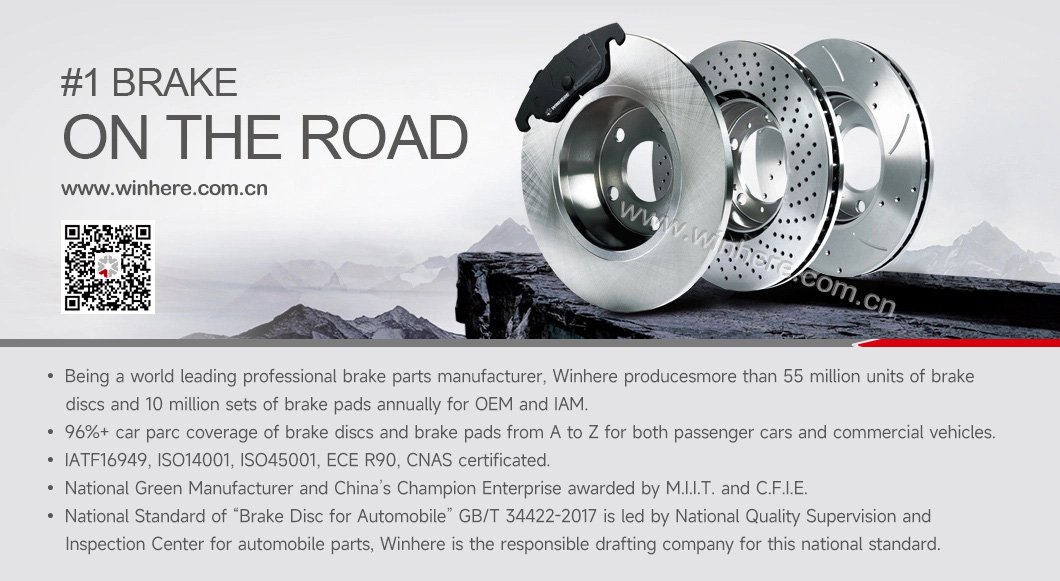
• ECE R90 certification confirms that this disc meets the braking performance standards for European aftermarket use, with documented dynamometer testing validating its friction coefficient, speed sensitivity, and thermal stability. The IATF 16949-certified production facility ensures consistent quality and dimensional accuracy, while the ISO14001 and ISO45001 certifications reflect environmental and occupational standards. For Honda owners, fleet operators, and distributors serving the global aftermarket, this composite solid disc delivers traceable, documented quality—a brake component that proves the virtue of simplicity in a market increasingly dominated by complex designs.
Test and Inspection

100% critical dimensions, runout and DTV inspection
Material physical and chemical inspection
Test shear strength, compressibility, density, flatness and parallelism
Test performance and noise/NVH
Catalogue

Certifications