


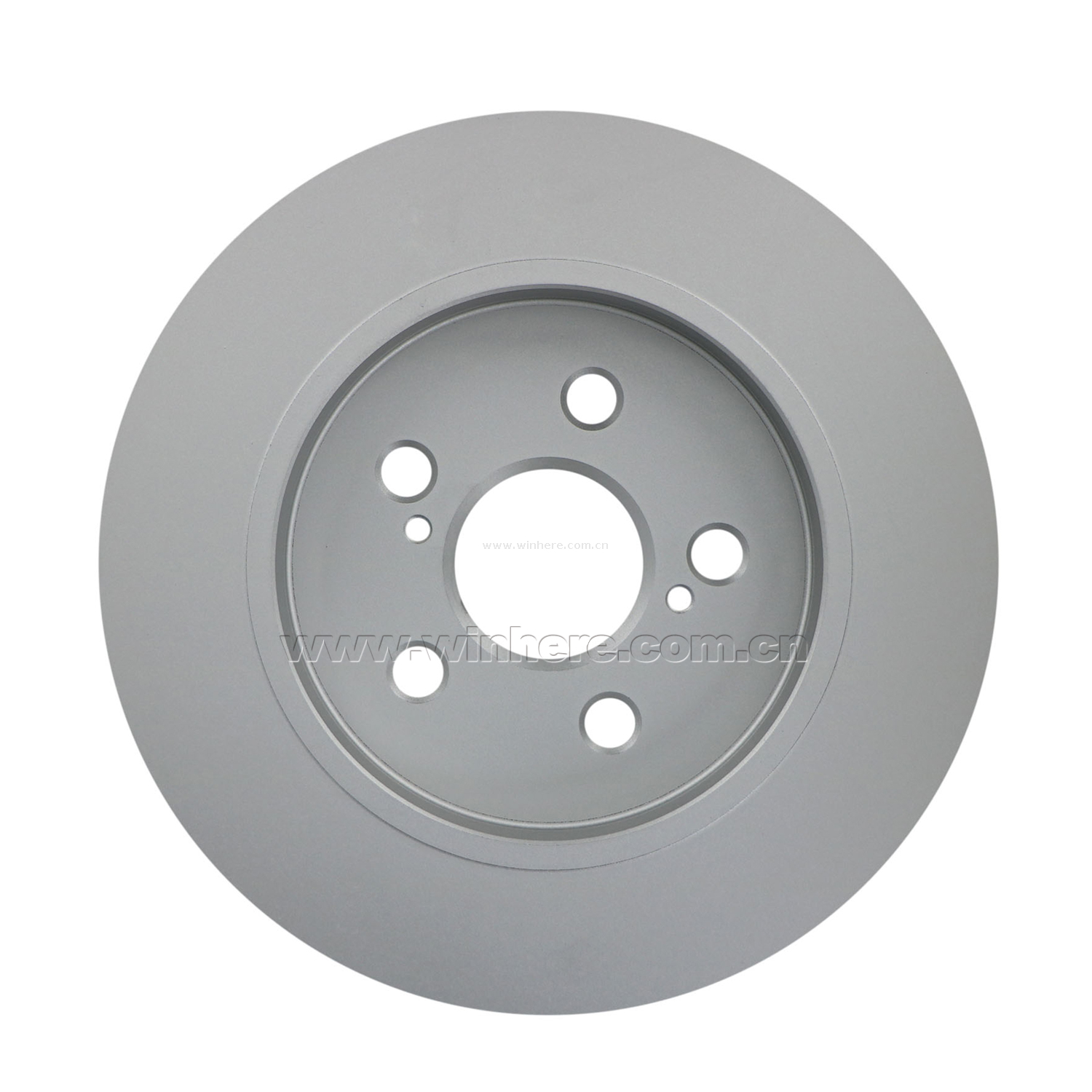

| Size: | |
|---|---|
| Quantity: | |
OE#4243102250/4243102200/4243112310/19184534/4243102260/YH1804
Private Label, Customized Label
8708309990
Company Profile
Products

Brake Discs Features:
•Equivalent to OE design
•Smooth and quick stop
•Anti-rust
•Low noise, low dust
•Optimal thermal performance
•Improved Pedal Feel: By resisting warping and providing a consistent surface, a high-quality rotor contributes to a firm, confident brake pedal. You get linear feedback without the pulsation or "shudder" associated with warped, low-quality rotors.
•Rotor Warping: This is often the most common complaint. Warping causes a pulsating brake pedal and is frequently the result of a rotor's inability to handle and dissipate heat effectively—a key area where quality matters.
1. Regulatory Approval and Vehicle Compatibility
The disc carries ECE R90 certification, confirming that it meets European safety standards for replacement brake components.
It is specifically designed for the rear axle of vehicles from Lexus, Subaru, and Toyota, ensuring correct fitment and balanced braking performance.
The same platform can also accommodate other applications, as indicated by related keywords (e.g., hybrid, heavy‑duty variants).
2. Surface Protection – Three Treatment Options
To address corrosion resistance and aesthetic preferences, the discs are available with different surface finishes:
Oiled brake disc
Treated with a thin anti‑rust oil film that protects the disc during storage and transport.
The oil is easily removed before installation, leaving a clean, bare iron surface for optimal pad bedding.
Painted brake disc
Coated with a durable paint layer – often on the hub and outer edge – to prevent rust and enhance visual appeal.
The paint helps maintain a neat appearance even after prolonged exposure to moisture and road debris.
Coated brake disc
Features an advanced protective coating (such as zinc or geometric coating) that provides long‑term corrosion resistance.
Unlike paint, the coating is typically applied to the entire disc surface, including the friction area, and is designed to wear away gradually during normal braking without compromising performance.
3. Structural Design – Drilled, Slotted, and Ventilated
The disc’s geometry is tailored to different driving conditions:
Drilled brake disc
Incorporates holes drilled through the friction surface.
These holes improve heat dissipation and help expel water and brake dust, enhancing wet‑weather braking and reducing pad glazing.
Slotted brake disc
Features curved or straight grooves machined on the surface.
The slots continuously wipe the pad surface, removing gases and dust that can reduce friction, and they also improve initial bite.
Drilled and slotted combinations (implied by the presence of both keywords) are also available, offering a balance of cooling, cleaning, and aggressive pad engagement.
Ventilated brake disc
Indicated by the keyword “GG15HC Ventilated” – this design uses internal vanes between the two friction faces to promote airflow.
Ventilation significantly reduces heat buildup, making it ideal for frequent heavy braking or high‑load applications.
4. Material Grades and Specialised Variants
GG15HC is a recognised high‑carbon cast iron grade often used in brake discs. It provides good thermal conductivity, wear resistance, and damping properties – contributing to stable braking and reduced vibration.
Silicon carbide brake disc
A material option for high‑performance use. Silicon carbide offers excellent heat resistance and light weight, often associated with superior fade resistance and extended disc life under extreme conditions.
Hybrid applications suggest discs engineered for hybrid vehicles, which may have specific requirements such as lower drag or regenerative‑braking compatibility.
Heavy‑duty brake disc
Designed for vehicles that operate under severe conditions – e.g., towing, commercial use, or frequent mountain driving. These discs are typically more robust in terms of thickness and heat capacity.
5. Manufacturer’s Capabilities – Winhere
Winhere is a well‑established Chinese brake component manufacturer with extensive experience in both OE and aftermarket supply.
The company applies strict quality controls to ensure dimensional accuracy, run‑out tolerances, and surface finish consistency – all critical for smooth, noise‑free braking.
Winhere’s global export footprint and compliance with international standards (including ECE R90) underscore its reliability as a supplier.
6. Summary of Key Features
ECE R90 certified for safety and regulatory compliance.
Designed specifically for Lexus, Subaru, and Toyota rear axles.
Three surface treatments: oiled (temporary protection), painted (cosmetic and anti‑rust), and coated (long‑term corrosion resistance).
Three structural options: drilled (cooling/water evacuation), slotted (gas/dust removal), and ventilated (enhanced heat dissipation).
Material choices range from GG15HC cast iron to silicon carbide, with variants for hybrid and heavy‑duty use.
Backed by Winhere’s manufacturing expertise, ensuring consistent quality and performance.
Test and Inspection

100% critical dimensions, runout and DTV inspection
Material physical and chemical inspection
Test shear strength, compressibility, density, flatness and parallelism
Test performance and noise/NVH
Catalogue

Certifications