Views: 0 Author: Site Editor Publish Time: 2026-09-22 Origin: Site
Vehicle owners shopping for replacement brake components often hit an immediate friction point. You open an auto parts catalog, read a mechanic's quote, or browse automotive forums, only to find conflicting terminology. One source tells you to buy rotors. Another insists you need discs. This terminology clash creates unnecessary purchasing hesitation. Nobody wants to buy the wrong part, especially when dealing with safety-critical systems like your vehicle's brakes. Drivers often confuse the overall braking system, the friction pads, and the rotational stopping surface itself.
Let us clear this up immediately. When looking at a brake disc vs brake rotor, you are looking at two names for the exact same component. There is zero mechanical difference. The variance is purely linguistic. We need to pivot our focus away from confusing terminology. Instead, we must look at the actual purchasing decision. You need to know how to evaluate, select, and install the correct replacement part based on your vehicle application, metallurgy, and structural design.
Terminology: Brake discs and brake rotors are identical components; the variance is purely linguistic, driven by regional dialects (European vs. North American) and engineering nomenclature.
System Context: The brake disc/rotor is the heavy, flat, circular metal component that the brake pads clamp down on to stop the vehicle.
Wear Cycles: Brake pads are made of softer friction materials and require frequent replacement, whereas brake discs are hard metal heat sinks designed to last through multiple pad lifecycles.
Selection Criteria: Purchasing decisions should be based on structural design (blank, slotted, drilled), metallurgy (cast iron, high-carbon), and driving application (commuting vs. towing/track).
Implementation Reality: Proper installation requires matching the rotor material with appropriate brake pads and executing a strict bedding-in procedure to prevent uneven wear and vibration.
Table of Contents
The automotive industry operates globally, but local dialects heavily influence part names. European markets and global engineering contexts almost exclusively use the term "brake disc." European vehicle manufacturers write this into their service manuals and engineering schematics. Conversely, the North American automotive aftermarket standardized the term "brake rotor." If you walk into a parts store in the United States or Canada, the counter staff will ask what rotors you need for your truck. Both terms describe the exact same piece of cast iron bolted to your wheel hub.
Understanding the etymology helps clarify the confusion. The word "disc" refers directly to the component's physical shape. It is a large, flat, circular disc. The word "rotor" refers to its mechanical function. It is a rotating mass attached to the wheel hub. One name describes what it looks like. The other name describes what it does. Neither name is wrong, but using them interchangeably causes headaches for consumers trying to order replacement parts online or over the phone.
People frequently confuse "disc brakes" with "disc rotors." Disc brakes refer to the entire braking assembly at the wheel. This complete system includes the brake calipers, hydraulic brake lines, mounting brackets, friction pads, and the rotational surface. The rotor is just one specific component within that broader system. It is the heavy spinning metal part. You cannot buy a "disc brake" as a single part. You buy the individual components that make up the disc brake system.
Mapping out the system eliminates further confusion. The system relies on several mechanical components working together to stop thousands of pounds of moving metal.
Brake Caliper: The hydraulic clamp mounted to the steering knuckle.
Brake Pads: The steel backing plates holding the sacrificial friction material.
Brake Rotor/Disc: The cast iron heat sink bolted directly to the wheel hub.
Caliper Bracket: The structural bridge holding the pads in proper alignment.
Slide Pins: The lubricated metal pins allowing the caliper to float and apply even pressure.
When you press the brake pedal, hydraulic fluid forces the caliper to squeeze the brake pads against the spinning rotor. This physical friction generates immense heat, slowing the rotational speed of the wheel.
Consumer uncertainty at checkout persists because the industry refuses to standardize. Original Equipment Manufacturer (OEM) service manuals often mix the terms depending on who translated the document. Aftermarket parts databases might list a part as a rotor in the title but call it a disc in the description. Furthermore, motorcycle and powersports manufacturers almost exclusively use the term brake disc globally. This cross-pollination of terms leaves DIY mechanics second-guessing their shopping carts. Knowing they are identical gives you the confidence to proceed with the repair.
Brake systems rely on two primary wear items: pads and rotors. They feature vastly different material constructions. Brake pads consist of softer, sacrificial friction materials. Manufacturers use semi-metallic compounds, ceramic blends, or organic fibers. These materials are designed to degrade slowly and turn into dust. Brake rotors consist of hard, heavy metals. Foundries cast them from iron or steel to withstand immense structural stress and extreme temperature fluctuations. The soft pad sacrifices itself against the hard rotor to stop your vehicle.
Maintenance expectations differ wildly between these two components. Because brake pads utilize softer materials, they wear out much faster. You will replace your brake pads frequently. Rotors, being solid metal, slowly lose their minimum thickness over thousands of miles. You do not need to replace rotors every single time you change your pads. A high-quality rotor typically lasts through two or three pad lifecycles. This depends heavily on your driving habits, vehicle weight, and the aggressiveness of your chosen brake pads.
Component | Primary Material | Wear Rate | Replacement Indicator |
|---|---|---|---|
Brake Pads | Ceramic, Semi-Metallic, Organic | High (Sacrificial) | Friction material thickness drops below 3mm, or wear sensor triggers. |
Brake Rotors | Cast Iron, High-Carbon Steel | Low (Long-term wear) | Thickness drops below OEM minimum specification stamped on the hat. |
Before buying parts, you must understand their primary job. A brake rotor acts as a massive heat sink. When pads clamp down, kinetic energy converts directly into thermal energy. The rotor absorbs this heat and dissipates it into the surrounding air through its internal cooling vanes. If a rotor cannot shed heat fast enough, the brakes experience fade. The pedal goes soft, and stopping power vanishes. Every purchasing decision must prioritize thermal capacity and structural integrity over visual aesthetics.
You face a choice between OEM parts and aftermarket alternatives. OEM components guarantee exact fitment. They provide the baseline performance engineered specifically for your vehicle chassis. Aftermarket options offer a much wider spectrum. You can find budget-friendly economy parts for cheap repairs. You can also find severe-duty upgrades designed for extreme conditions. Economy aftermarket parts often use inferior metal casting, leading to faster wear and poor heat dissipation. Premium aftermarket parts often exceed OEM specifications, offering better cooling vane designs and superior corrosion resistance.
Never buy brake components blindly. You must evaluate your specific use case. A daily commuter driving a lightweight sedan needs different brakes than a contractor towing a heavy equipment trailer. Mountain driving requires high thermal capacity to handle long downhill descents without boiling the brake fluid. High-performance track use demands specialized metallurgy to survive extreme heat cycles. Match your rotor design and material directly to how you actually use the vehicle. Overbuying wastes money. Underbuying compromises your safety.
Rotors come in several distinct physical designs. Each design alters how the component handles heat, gas, and friction. Choosing the wrong design for your application causes premature failure. We must look at the features, the mechanical outcomes, and the best use cases for each style.
Rotor Design | Key Features | Mechanical Outcomes | Best Application |
|---|---|---|---|
Blank (Smooth) | Solid, uninterrupted surface area. No holes or slots. | Maximum structural integrity. Quietest operation. Longest pad life. Excellent heat sink mass. | 90% of daily drivers, luxury vehicles, standard commuting. |
Slotted | Shallow channels machined into the rotor face. | Allows hot gases, dust, and water to escape. Prevents brake fade. Slightly increases pad wear. | Towing, hauling heavy loads, off-roading, aggressive street driving. |
Drilled | Holes drilled completely through the rotor metal. | Excellent initial bite and water dispersion. Highly susceptible to stress-cracking under extreme heat. | Wet climates, aesthetic upgrades, light street performance. |
Drilled & Slotted | Incorporates both machined channels and drilled holes. | Balances gas routing with initial bite. Retains the structural risks of drilled variants. | High-performance street vehicles, specific aftermarket big-brake kits. |
Blank rotors feature a solid, uninterrupted friction surface. They offer the maximum possible surface area for the brake pad to contact. This design provides maximum structural integrity. Because there are no machined cuts, blank rotors operate quietly and maximize brake pad life. They hold the most physical mass, making them excellent heat sinks. Blank rotors are the correct choice for the vast majority of daily drivers, luxury vehicles, and standard commuters. They provide the most consistent, reliable stopping power for everyday use.
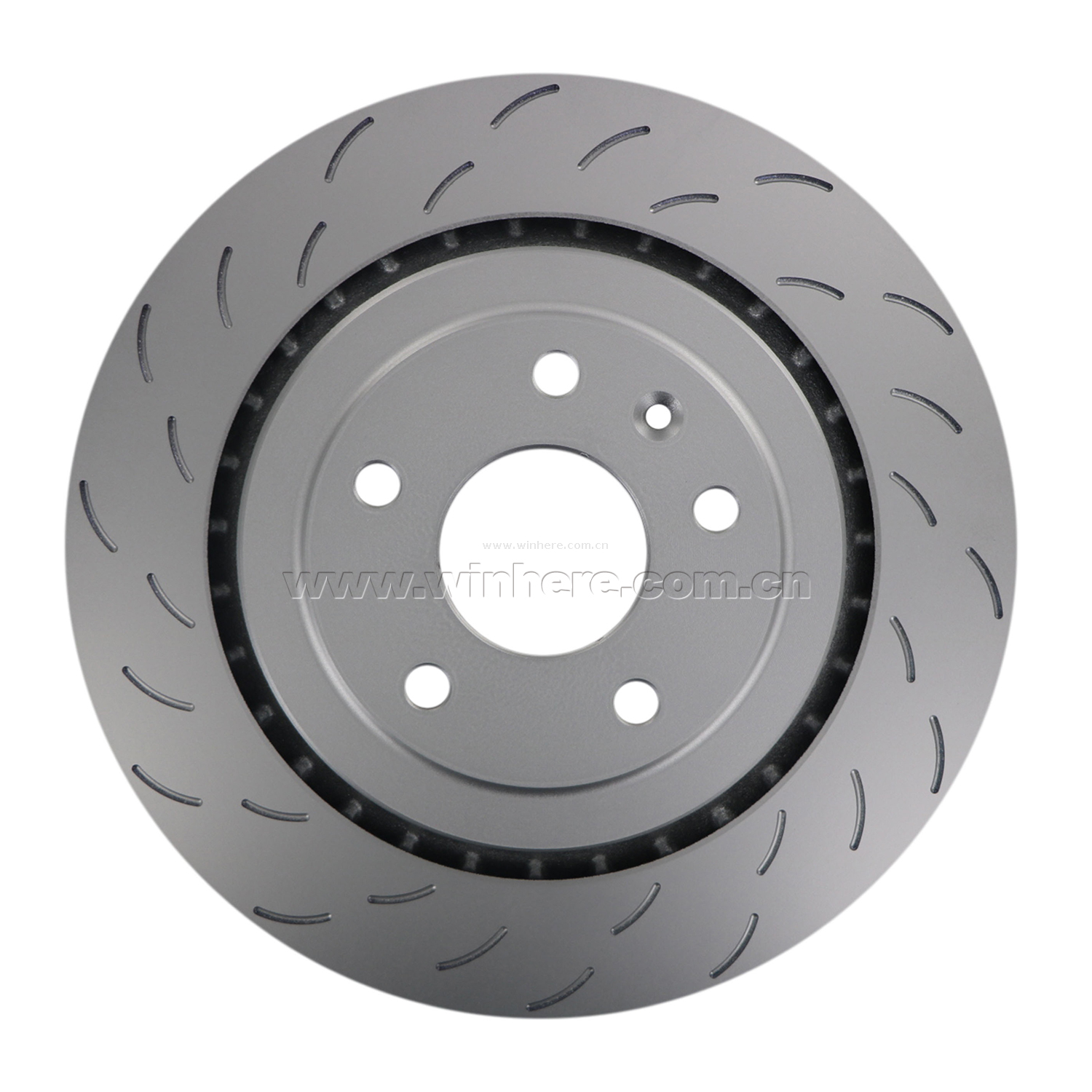
Slotted designs feature shallow channels machined directly into the rotor face. Under heavy braking, friction materials release hot gases and dust. These slots give those byproducts an escape route. This prevents a boundary layer of gas from forming between the pad and rotor, which eliminates a major cause of brake fade. The slots also wipe the pad surface clean. This slightly increases pad wear but ensures consistent stopping power. A slotted Brake Disc is ideal for towing, hauling, and off-roading where heavy loads put extra strain on the braking system.
Drilled rotors have holes machined completely through the metal. These holes provide excellent water dispersion in wet climates. They also offer a strong initial bite when you press the pedal. However, drilling holes removes physical mass and compromises the structural integrity of the iron. Under extreme heat cycles, drilled rotors are highly susceptible to stress-cracking around the holes. They look great behind alloy wheels, making them popular for aesthetic upgrades, but they are not recommended for heavy track use or towing.
Combination rotors incorporate both channels and holes. They attempt to offer the best of both worlds. The slots handle gas routing and pad wiping. The holes handle water dispersion and bite. While they perform well on the street, they still retain the structural risks associated with drilled holes. Heavy thermal loads can still cause cracking between the drilled holes and the outer edge of the rotor. These are best suited for high-performance street vehicles and show cars equipped with aftermarket big-brake kits.
Standard gray cast iron serves as the baseline material for most passenger vehicles. It is highly cost-effective to manufacture. Cast iron provides reliable heat capacity and decent durability for standard driving conditions. However, it is very heavy. Standard iron is also highly prone to surface rust. If you leave a car sitting in the rain, standard cast iron rotors will develop a layer of orange oxidation within hours. The first stop usually scrapes this rust off the friction surface, but the non-friction areas will continue to corrode over time.
Premium aftermarket parts often utilize high-carbon cast iron. Foundries alter the metallurgical mix to include a higher percentage of carbon. This creates a denser graphite flake structure within the metal. High-carbon rotors offer significantly better thermal conductivity. They pull heat away from the friction surface faster. They also boast a higher resistance to thermal cracking. Furthermore, the denser material provides superior vibration dampening. This results in noticeably quieter braking and less squeal during low-speed stops.
Corrosion destroys brake components long before friction wears them out. Coated rotors solve this problem. Manufacturers apply anti-corrosion treatments, such as zinc plating or GEOMET coatings, to the entire rotor. Once installed, the brake pads quickly scrape the coating off the friction surface. However, the coating remains on the non-friction surfaces, including the central hat and the internal cooling vanes. This prevents rust buildup, which is absolutely critical for drivers living in regions with salted winter roads. Rusted cooling vanes block airflow, leading to severe overheating.
Carbon-ceramic represents the extreme high end of brake metallurgy. These rotors are manufactured from a composite of carbon resin and ceramic fibers. They are incredibly lightweight, reducing unsprung mass on the vehicle. They can survive astronomical temperatures without fading or warping. However, the manufacturing process makes them massively expensive. A single carbon-ceramic rotor can cost thousands of dollars. They are strictly reserved for exotic sports cars, supercars, and dedicated track-only racing vehicles. They offer no practical benefit for a daily commuter.
Mechanics and drivers frequently complain about "warped" rotors. They feel a vibration in the steering wheel and assume the metal disc has physically bent like a potato chip. This is a myth. Modern cast iron rotors rarely warp. That steering wheel vibration is almost always caused by uneven brake pad friction material transfer. Overheating the brakes causes the pad material to melt and deposit unevenly onto the rotor surface. These cementite deposits create high spots, causing the pulsation you feel through the brake pedal.
You must match your friction material to your rotor metallurgy. Pairing aggressive, high-metallic track pads with cheap economy rotors results in disaster. The hard pads will chew through the soft iron, causing premature rotor wear and deep scoring. Conversely, pairing ceramic pads with standard rotors can sometimes cause heat retention issues. Ceramic pads do not absorb heat well, forcing the rotor to handle the entire thermal load. Always verify that your chosen pad compound is compatible with your rotor material to ensure safe stopping distances.
Installation does not end when you tighten the lug nuts. You must perform a strict bedding-in procedure. Bedding-in transfers an even, microscopic layer of pad material onto the bare rotor surface. Skipping this step guarantees uneven material transfer.
Accelerate the vehicle to 35 mph on a clear, safe road.
Apply moderate brake pressure to slow the vehicle to 5 mph. Do not come to a complete stop.
Repeat this process three to four times to build initial heat in the cast iron.
Accelerate to 55 mph and apply aggressive brake pressure to slow down to 10 mph. Repeat this four to five times.
Drive the vehicle at highway speeds for ten minutes with minimal brake application to allow the system to cool evenly.
Lateral runout destroys new brake jobs immediately. Runout occurs when the rotor does not spin perfectly flat. The most common cause is failing to clean the wheel hub before mounting the new rotor. Even a fraction of a millimeter of rust or dirt on the hub pushes the rotor out of alignment. As it spins, it wobbles. This wobble knocks the brake pads back and forth, leading to immediate brake pulsation.
Remove the wheel and the old brake components to expose the bare hub.
Use a wire brush or abrasive wheel to strip all rust and scale from the hub face.
Mount the new rotor and secure it tightly with conical lug nuts to simulate wheel torque.
Mount a magnetic dial indicator to the steering knuckle and place the needle on the rotor face, about half an inch from the outer edge.
Rotate the assembly by hand. If the needle moves more than 0.002 inches, remove the rotor, rotate it one stud hole, and test again.
Check your vehicle's OEM specifications to determine the baseline rotor size and required thermal capacity.
Inspect your current brake pads to see if a full axle replacement is necessary, as mating old pads to new rotors causes uneven wear.
Choose blank, fully coated rotors if you use your vehicle as a daily driver in wet or snowy climates.
Opt for slotted, high-carbon rotors if you frequently tow heavy loads or drive aggressively in mountainous terrain.
Consult a certified technician if you lack a dial indicator or the proper tools to measure hub runout during installation.
A: Yes. If your rotors meet the manufacturer's minimum thickness specifications and show no signs of deep scoring, cracking, or uneven material transfer, you can safely install new brake pads. However, you should always measure the rotor thickness with a micrometer to be certain.
A: Squeaking often results from high-frequency vibrations between the brake pad backing plate and the caliper. It can also occur if you skipped the bedding-in process, failed to apply anti-seize grease to the caliper slide pins, or chose a highly metallic pad compound.
A: A high-quality set of rotors typically lasts between 50,000 and 70,000 miles under normal commuting conditions. This lifespan drops significantly if you tow heavy loads, participate in track days, or frequently drive in stop-and-go city traffic.
A: No. Drilled rotors offer no practical braking advantage for standard daily commuting. Blank rotors provide more surface area, better structural integrity, and longer pad life. Drilled rotors are primarily used for aesthetic upgrades on street cars.
A: Machining involves putting the used rotor on a brake lathe to cut away a thin layer of metal. This removes high spots and old friction material, creating a perfectly flat surface for new pads. This is only possible if the rotor remains above minimum thickness.
A: Yes. Most uncoated rotors ship with a layer of rust-preventative packing oil. You must thoroughly clean the friction surfaces with brake parts cleaner and a clean rag before installation. Failing to remove this oil will contaminate your new brake pads.